


Toni is incredibly proud of her 6-year-old nephew, David. “Anyone that meets David instantly falls in love with his creative, gentle, and uplifting personality,” she said. Toni is part of the RUN FOR AUTISM team at the 2025 Bank of America Chicago Marathon, running for David, who was diagnosed with autism when he was 18 months old. “I can’t think of anyone else I’d want to run for.”
When Toni’s sister-in-law and brother learned they were pregnant with David, they were so excited to tell Toni’s dad that he would be a grandfather. He was elated, but sadly passed away before he could meet his first grandchild, David was born with his grandfather’s bright blue eyes and was named David in honor of him.
When David was young, his parents noticed he wasn’t really making eye contact or reacting to his name. His pediatrician initially suggested a wait-and-see approach as David was only 18 months old, but Reyna (David’s mother, Toni’s sister-in-law) did her own research and advocated for David to be evaluated for autism early. David was diagnosed with autism soon after, and started several therapies, including speech and occupational therapy.

When he was two, David started using an AAC (augmentative and alternative communication) device to communicate through pictures instead of words. At first, his parents printed out pictures he could point at to get ideas across, and velcroed these around the house. Then, he started using a device with a library of icons to communicate. When his parents considered the idea of an AAC device, doctors expressed mixed opinions on the idea, with some concerned it might slow down his spoken language development. However, David’s parents advocated for him to get the device. “I can’t express how proud I am of my sister for sticking with her gut feeling, even when then doctor said otherwise,” Toni said.
It took David some time to get used to the device, but soon he was using it to say full sentences and express what he wanted. “If you asked him a blue moon question, like ‘what’s your favorite color?’, he would navigate out of the food icons and click a color,” Toni said. “This is really helping him and letting him speak what he’s thinking,” she thought. He was showing he didn’t just have the locations of icons memorized but knew their meaning.
As David grew older, he started saying some words and using the AAC device less and less. His parents wanted him to decide on his own timeline if he wanted to keep using the device or give it up, and let him use it as much or as little as he wanted to. By the time he finished preschool at age four and a half, he completely stopped using the device. Now, David is in an inclusive first-grade class. While adjusting to school has brought some challenges, he’s getting used to school and is enjoying spending time with his friends.
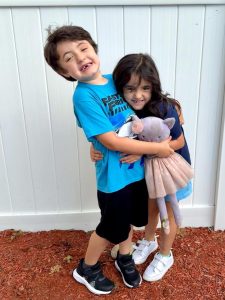
Among the many supporters in David’s life is his little sister, Kaylin. She’s just a year younger than David and has been instrumental in his development over the last few years. When they were both younger, no one knew how they’d get along and if they’d play well together, but they’ve become fast friends. She’s quite protective and supportive of David, and they play lots of imagination games together.
Toni is no stranger to charity marathon running – she’s run the Boston Marathon several times in honor of her Dad’s fight with cancer. However, she decided she wanted to change directions this year to run the Chicago Marathon in support of her brother, sister-in-law, and David. “He’s so special to everyone in my family.”
Blue Envelope Program Supports Autistic Drivers
The Blue Envelope Program, an initiative designed to improve communication between autistic drivers and law enforcement officers, has been adopted...
Find Your Crowd: Building Real Friendships Through Authenticity
I have collected Pokémon cards since I was about five years old. It felt like the most natural thing in the...
Why Connection Matters for Autistic Children
“Do autistic children really want friendships?” As parents and practitioners, we may have asked ourselves this question. If a child...