
Team Baby Bat runs the Bank of America Chicago Marathon
October 15, 2025
By: RUN Staff
Categories: Stories, Families, RUN FOR AUTISM


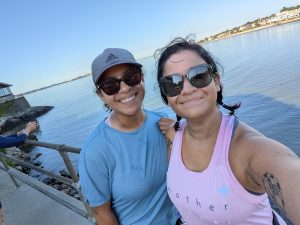
This October, friends Natalie and Corina laced up their running shoes for the 2025 Bank of America Chicago Marathon as part of the RUN FOR AUTISM team. The duo comprises team Baby Bat, named for Natalie’s daughter, Amaranta, who was affectionately nicknamed “Baby Bat” by Corina. Natalie and Corina wanted to run for a cause and picked the Organization for Autism Research as Amaranta is autistic, and “it’s important we support organizations that are doing scientific, evidence-based work for the autistic community,” Natalie said.
Amaranta, now four years old, was diagnosed with autism just before her third birthday. Her parents, Natalie and Kevin, felt something was always a little different about her, but they couldn’t pinpoint what it was. Over time, they put together the pieces, eventually resulting in an autism diagnosis and finding new ways to give Amaranta the support she needs.
As Amaranta’s first birthday approached, Natalie noticed she seemed to not respond to her name. After observing for a while, Natalie brought it up with a friend. “I think she doesn’t recognize her name,” Natalie said. “I need you to tell me if I’m going crazy.” Natalie also noticed it felt like Amaranta didn’t notice if she was there or not. She brought it up to Kevin, who agreed. They’d both been nervous to say those words out loud, afraid their instincts were wrong and it was just in their heads. “Are we crazy?” they thought. “What does this even mean?” Amaranta would mimic sounds but wouldn’t interact back with her own words. For instance, while she would repeat some of her ABCs, she wouldn’t say words like “yes,” “no,” or “mommy.” Yet, though she wasn’t saying individual words, she loved to sing and would mimic songs back to her parents. Both Natalie and Kevin are musicians, and they attributed some of her proclivity for singing words over speaking to this. But, “we could tell that she was trying to say something to us, but the words just weren’t coming out.” They asked Amaranta’s pediatrician for a language evaluation, also wondering if Amaranta was confused by her bilingual household, where Natalie spoke to her in Spanish and Kevin spoke to her in English. Her pediatrician said not to worry – she might be a little behind, but she’d catch up.
Baby Bat and her parents soon moved to Florida, where Amaranta’s new pediatrician did another language evaluation with her. This time, her pediatrician mentioned that Amaranta might be a Gestalt language processor, something common among autistic children. Children who are Gestalt language processors learn and use language in larger phrases and chunks before breaking down those phrases to understand the meaning of the individual words within them. Amaranta started speech therapy, which began to give her the tools to communicate more easily and helped with her frustration of not being understood.
Natalie and Kevin felt a few things still didn’t quite make sense. So, they decided, along with Natalie’s parents, that they would all start taking notes about Amaranta to bring up to her pediatrician. As they made their list, several common themes stood out. First, it seemed like Amaranta wasn’t aware of those around her and didn’t respond to her name. She also had rigid mental categorization of things in her life and struggled when things didn’t fit neatly into those frameworks. For instance, pasta could only be eaten at her Abuelo’s house, not at home. Amaranta got upset when she saw her mom speaking in English, as in her eyes, her mom was only supposed to communicate in Spanish, like she did with Amaranta. She also struggled with crowded or loud places, like restaurants, where her parents would take turns taking her outside for a walk when the setting was too stimulating. They also noticed that Amaranta seemed to click with autistic children in social settings like the playground. “Autistic kids can match her energy and enthusiasm, and they were okay with her stims,” Natalie said.
Armed with their observations, Natalie and Kevin took Amaranta to a pediatric neurologist for evaluation. After a battery of questionnaires and interviews, the doctor diagnosed Amaranta with autism and gave her parents referrals for different therapies that could support her.
In the year and a half since her diagnosis, Amaranta has been in speech, occupational, music, and aquatic therapy, all of which have helped her blossom. Through music therapy, she worked on interacting with others to share stories and show interest in others. She bonded with her music therapist almost immediately. Over his career, he worked with both autistic children and adults with Alzheimer’s disease, and he and Amaranta sang together and used music to tell stories and ask questions. Over time, Amaranta started to tell her music therapist stories, something she hadn’t done with her parents. While music therapy got too logistically complicated to continue, she loved the nine months she participated in it.
Amaranta also started aquatic therapy to become safer around water and to work on following instructions and imitating motions. She’s an eloper and loves jumping into bodies of water, so it was important for her to learn how to swim at a young age to be safe around water. It’s also an environment she loves. “She loves water so much,” Natalie said, “Being in that environment was really helpful for her.” She can now float and hold herself up in water and is starting to get the hang of doing strokes with her arms and legs. Aquatic therapy has also helped with following directions. “If it were up to her, she would just jump in the pool for an hour,” Natalie said. “But she’s learning that there are other things she has to do as well.”
Today, Amaranta is four years old. She’s a student in a Montessori preschool, which she loves. She’s writing her name, can count, and loves singing, dancing, and saying hi and introducing herself to everyone. “She’s doing really well,” Natalie said.
Natalie and Corina ran for Amaranta, and others like her, this fall in the 2025 Bank of America Chicago marathon. “Something I’m proud of as a parent is that Kevin and I weren’t freaked out by the possibility of her being autistic, but instead, we wanted to make sure she gets the support that she needs so she can be the best person that she can [be],” Natalie said. “It was an emotional journey, and it still is, but we try to focus on the progress that she’s made and celebrate the little accomplishments so far.”
Blue Envelope Program Supports Autistic Drivers
The Blue Envelope Program, an initiative designed to improve communication between autistic drivers and law enforcement officers, has been adopted...
Find Your Crowd: Building Real Friendships Through Authenticity
I have collected Pokémon cards since I was about five years old. It felt like the most natural thing in the...
Why Connection Matters for Autistic Children
“Do autistic children really want friendships?” As parents and practitioners, we may have asked ourselves this question. If a child...