


Ten years ago, when Aidan, my profoundly autistic son, was 14, I had all kinds of ideas about what his adulthood might look like. I often swung between hope and fear. On hopeful days, I envisioned that he would live in a cool community with his peers; we’d start a business (I even bought a domain name for an imagined bakery); and he would have an amazing day program filled with a wide variety of activities. I made lists of these scenarios. Over the years, I toured planned communities and programs. I brainstormed with other parents. At one parent gathering, we came up with a hierarchy of needs that would constitute a good life for our adult children:
On the many difficult days throughout Aidan’s adolescence when he struggled with self-injury and elopement, days when I would have given my right arm for him to be able to tell me how to help, my imagining about his future was tinged with darkness and fear. I made another list, which described a very different future:
Planning for Aidan’s future had to include building a solid shield against this bleak list. As painful as it was to consider these outcomes, it was important to define them.
Parenting a minimally communicating child requires learning how to tune in and guess as best we can whether our loved one is happy or hurting, excited or dysregulated. When he was little, we tried a lot of activities with Aidan, like baseball (nope), yoga (total failure! Autism + serenity = dark comedy), music, swimming, hiking, and gymnastics. There were many excruciating days interlaced with moments of triumph.
We learned that the key to knowing whether Aidan enjoyed something was to try it multiple times. His extreme sensory challenges often blocked him from experiencing life, so it was important not to deprive him of activities right off the bat if he seemed overwhelmed. Repetition and consistency became foundational throughout his childhood and adolescence. Even on tough days, we tried to support him through his sensory difficulties so he could be a part of the world, have adventures, and learn new skills.
His team of community aides, teachers, and a devoted occupational therapist helped us with burnout and offered new ideas for when we seemed stuck. Though we didn’t know it, we were already building an idea of what life could look like as he got older by developing his strengths and scaffolding his vulnerabilities time and time again: lather/rinse/repeat.
During the year leading up to Aidan’s graduation from school, we toured several local day programs,
none of which were right for him. Many didn’t have enough staff. One program seemed decent but was situated right next to a busy train track, a nonstarter for my athletic runner. Another program said Aidan was welcome to enroll if he had “no behaviors,” a requirement that made me laugh out loud. I kept thinking there had to be a great or even halfway decent program somewhere. But the longer I looked, the more it dawned on me that we might have to make it up as we went along.
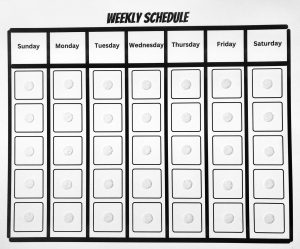
And then the moment we’d been waiting for finally came. School ended and Aidan fell off the disability services cliff into what another autism parent had warned me about: the whiteboard of nothingness. Meaning, the big weekly calendar on his wall was empty. How were we going to fill it? It seemed like the ever-elusive day program was, in fact, non-existent. We were going to have to come up with something ourselves.
To fill up Aidan’s whiteboard, we had to expand on his hierarchy of needs:
Whenever I felt overwhelmed during this process I would say to myself, “He just needs to have places to go and things to do.” The simplicity of this phrase reminded me that Aidan didn’t need something spectacular and therefore unsustainable. “Places to go and things to do” felt less intimidating, more achievable than “the perfect day program.”
The first square to go up on the whiteboard was art class. Aidan liked to paint, so it made sense. But where? And with whom? I put the word out on social media that we were looking for a classroom for autistic adults. A local art center responded to the call. Next, I made a list of every family we knew whose adult child had finished school. Then, I made a simple group page on Facebook where we could schedule events. Around 40 families responded; three to five ended up consistently attending, which was a good number for our high-needs adults. Once we had a small group established, other activities followed: matinee movies at a $5 movie house, beach days, pizza meet-ups, all low-cost and local, which made it easier for Aidan’s community to get together and build rapport every week.
Aidan’s two community aides have been helping to fill in the rest of the whiteboard: gym, pool, park, hikes, mall, and Taco Tuesdays. Two years ago, it was a struggle for Aidan to tolerate a 15-minute activity. Now, he leaves the house in the morning and returns at the end of the day. He has gained independence and resilience far beyond my wildest dreams. This would not have been possible without his staff and therapists, all of whom are part of his adult services. With his team, Aidan is developing a life beyond his old routines. Although he lives at home, he spends most of his time out in the world without his parents.
The process hasn’t always been smooth. Aidan has fought through extreme sensory challenges to adapt to his post-school life. With repetition and consistency, he has not only adapted, he is flourishing. While I’m under no illusions that we’re all living happily forever after (profound autism has taught me to live in the moment as much as possible), Aidan’s life often looks a lot like that list I made years ago: he is safe, he has a community, he engages in meaningful activities, and he’s happy most of the time. I used to think I needed to find some ideal program/setting/community/magic wand for him when he reached adulthood.
But as Aidan has taught me repeatedly over our journey together, our path doesn’t ever go in a straight line. There is no magic wand. Instead, we start small: making lists, keeping things consistent, building community, and learning and re-learning how to operate in the world. Lather/rinse/repeat.
 Kate Movius is the founder of Autism Interaction Solutions, whose mission is to provide effective training in autism safety and communication tactics for first responders. She is the primary disability trainer for the Los Angeles Sheriff’s Department and her work has been profiled by Psychology Today, US News and World Report and CBS, among others. A founding member of the LA Found Taskforce, she also works with county leadership to minimize the risks of wandering for people with Alzheimer’s and autism. She is the proud mom of two sons, one of whom has profound autism.
Blue Envelope Program Supports Autistic Drivers
The Blue Envelope Program, an initiative designed to improve communication between autistic drivers and law enforcement officers, has been adopted...
OAR Welcomes New Hire Autism Navigators
Along with the spring sunshine, OAR’s Hire Autism Program warmly welcomed seven new talented navigators. Congratulations to Jenine B., Cristian...
Social-Emotional Development and Communication for Young Children
In October 2025, OAR’s Board of Directors authorized funding for eight applied autism research grants. These new research grants, totaling...