
Meeting New Colleagues and Building Relationships
December 17, 2025
By: Hire Autism
Categories: Self-Advocates, Employment


The adjustment period from one job to another or from school to the workplace can be challenging, partly due to the change in social dynamics. You are transitioning from one set of friends or colleagues to another and learning about new people with different personalities, communication preferences, and work styles. This transition into a different environment can be a bit jarring at first, but with the right tools, you can start to feel more at ease. This article will guide you through the transition to a new job, meeting new colleagues, and navigating conflicts.
One of the best tips for a smooth transition is to prioritize getting to know some of your new colleagues within the first few weeks of your start date. Although socializing with strangers can be intimidating, building this foundation has been linked to improved mood, increased productivity, and career growth.
You can help others understand who you are by sharing more information about your position, your passions, the strengths you bring to the organization, and how best to support your needs. You may also find you share similar interests, backgrounds, and goals with your peers, which could be the start of a great professional relationship.
 It may sound simple, but knowing the names of those in your company can help you feel more comfortable approaching colleagues with questions or concerns. If remembering names is not your strong suit, many company websites have a staff page where you can familiarize yourself with names, faces, and professional titles before you interact.
If it is not part of your onboarding already, ask to schedule a one-on-one meeting with different staff members, especially the ones with whom you will be working most closely. You can also meet others casually during a break or lunch hour. Scheduling formal and informal meetings can help you become more accustomed to the workplace culture and the structure of each department’s responsibilities. It can also help you learn more about your coworkers’ personalities and communication styles, which is beneficial when collaborating on projects.
First impressions often last, and your reputation follows you throughout your career. Therefore, creating a positive impression on your coworkers early-on can be critical to your growth as a professional. You can achieve this by being productive, delivering your best work, asking thoughtful questions, and maintaining a positive attitude.
Sometimes, the simplest things are the most memorable. Warm salutations, such as “good morning” and “have a good weekend,” signal basic consideration toward your new colleagues. Dressing professionally, arriving early, and preparing an elevator pitch can show an employer your time management, reliability, and professionalism from day one.
If you are struggling with onboarding or training, don’t hesitate to ask for help. This demonstrates that you care about the quality of your work and will take initiative when a problem arises.
As you transition into the workplace, you will develop various types of relationships with your colleagues, including general coworker relationships, mentorships, and collaborative team member relationships, which will continue to evolve throughout your career at the organization.
Sometimes, we transition to employment without knowing how to develop these relationships. As such, it is essential to build and nurture interpersonal skills to enhance your colleagues’ perception of you and help interactions run smoothly. These traits are ones you can utilize in your communication and professional relationships.
Examples of these interpersonal skills include:
These skills are not gained overnight and need months or even years of practice and deliberate effort to sharpen, but here are some places you can begin.
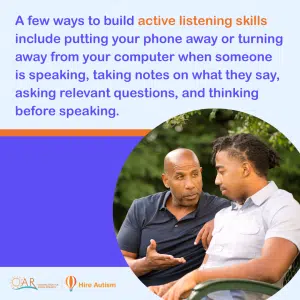
Active listening is essential for effective communication and healthy dialogue. A few ways to build active listening skills include putting your phone away or turning away from your computer when someone is speaking, taking notes on what they say, asking relevant questions, and thinking before speaking.
Use the employee handbook to learn more about expectations for the dress code, communication preferences (does your organization prefer Slack, Discord, e-mail, etc.?), and office etiquette. You can also learn about company culture and operations by talking to your direct supervisor and other team members.
Just as you may need specific accommodations, your colleagues are also unique and may have various support needs of their own, so it is helpful to learn how you can respect those needs. Role-related differences, sensory sensitivities, and life circumstances are examples of reasons for different support needs among colleagues.
 For example, some people may feel more comfortable using online messaging for communication, while others may prefer conversations on the phone or in person. Your colleagues may clock in or out at different hours, so you may need to strategize what times are best to contact them. There may be an employee who is very organized and tidy and prefers to work in a highly structured environment. You may also have another colleague who prefers to work independently without much support from the team.
Each of your colleagues may have an entirely different way of processing information or working through tasks. With this in mind, try to be patient with those around you and listen to the needs of others as you would hope they’d listen to you. Work to create sensory-friendly spaces (i.e., do not blast your own music), be clear in your communication, and engage in continuous learning and adjustment.
One of the most important (and difficult) parts of interpersonal skills is recognizing that we are imperfect and that we will make mistakes or need support at times. Therefore, asking for and accepting constructive criticism is a valuable way to learn from others, show humility, and demonstrate a willingness to learn, grow, and improve as both an individual and an employee.
When an organization faces difficult times or a project doesn’t meet expectations, stay positive and continue giving your best. Many workplaces value employees who maintain a positive attitude and demonstrate resilience during tough situations.
With the social nature of employment and such a diverse range of backgrounds, personalities, and neurotypes in the workplace, conflict can arise. Navigating conflict can be uncomfortable, but it is essential to maintaining positive workplace relations with colleagues and preserving your mental well-being.
Not every relationship will be 100% free of disagreements or tension, but communicating important boundaries can help prevent many conflicts before they escalate. As there are different ways conflict might arise, it is beneficial to understand what you and your colleagues need to feel safe and accepted in the workplace environment. Advocating for your needs in a polite and effective manner is a skill that shows your team the respect you have for yourself, which should not be discounted. Encourage others to advocate for themselves, too. It can’t be assumed that their boundaries are the same as yours, so it’s important to understand and respect the needs they communicate to you.
There are different types of boundaries you can set, including:
Consider which aspects of your life are most important to you. For example, you may be a parent who needs to establish specific working hours to accommodate your child’s needs. You might have specific sensory needs, such as a quiet room, access to headphones, or established break times. Being honest with yourself about the amount of work you can take on at one time is key to avoiding burnout, navigating deadlines, and producing quality work sustainably. Communication to your supervisor about these workload boundaries is critical, as it gives them the tools to support you and delegate more thoughtfully, and it enables you to feel a sense of agency over your career.
When conflict does occur, avoid escalating it with immediate, emotionally charged conversations. If you feel frustrated, angry, confused, or similar, take time to evaluate the situation and understand how the problem affects your work. Addressing concerns calmly can help both sides resolve issues more quickly.
For minor issues between peers that can be resolved through direct conversation, consider scheduling a one-on-one meeting to discuss your concerns. Handling the conflict privately in a neutral space rather than announcing the drama in front of other team members can actually build some respect between you and that one team member in the long run.
Before starting, establish ground rules, such as speaking without interruption and listening respectfully to one another. Focus on the areas where both of you agree, as this can help each party realize they’re on the same team and working toward similar goals, even if they approach these goals differently. By highlighting shared interests, you can turn potential conflicts into opportunities for collaborative problem-solving.
If the issue is serious and remains unresolved after a one-on-one conversation, or if it involves a recurring pattern of behavior, bring your concerns to your supervisor so they can help you manage the conflict. The discussion may require a neutral third party to facilitate the conversation.
Each of your colleagues has a unique approach to accomplishing tasks, communicating, and meeting their needs. Therefore, working to meet each individual colleague where they are and allowing them (and yourself) the freedom to make their own work-related decisions can build trust and strengthen working relationships.
When you experience conflict with a colleague, assuming the worst or gossiping about them to your peers is never the best approach. Instead of showing contempt, communicate your concerns directly using “I” statements that focus on how the situation made you feel. For example, “I feel uncomfortable/misunderstood/unheard when my ideas are dismissed.” This method helps your peers understand your emotions as less of an attack on them.
Be specific and be prepared to offer a solution on how best to move forward. To strengthen your statement, you could say, “I feel uncomfortable/misunderstood/unheard when my ideas are dismissed in our meetings. It would help me feel more comfortable if you acknowledged my ideas, asked questions, and granted me some time to explain my way of thinking.”
Take the time to listen to your colleagues’ perspectives. This helps you better understand their viewpoints while ensuring they feel heard and acknowledged. A compromise happens when each side gets some of what they want, but not everything. In this situation, no one is completely dissatisfied with the outcome. These discussions can be tough in the moment, but when you’re later asked in job interviews about how you handle stress and conflict, a well-handled resolution will give you a great answer.
Find Your Crowd: Building Real Friendships Through Authenticity
I have collected Pokémon cards since I was about five years old. It felt like the most natural thing in the...
Making the Most of Open-ended Interview Questions
The interview process is a critical component of a job application. It is an opportunity for you to connect one-on-one...
Your Support Made the Difference!
Each year, OAR lays out ambitious goals for engaging community members in celebration of Autism Acceptance Month. Throughout the beginning...