
Considerations Before Resigning from a Job
March 20, 2026
By: Hire Autism
Categories: Employment, Career and Money


Much like the pursuit of a job, the decision to leave a role requires self-reflection, caution, and professional behavior throughout the process. No matter your reasons, if you are considering resigning from your current job, this article will help you evaluate your options and make a decision that supports your goals and well-being.
What you hope to gain from leaving a job is likely tied to the reasons you wish to resign in the first place. If your current workplace harms your physical or mental health, resigning may improve your overall well-being and reduce professional burnout.
Leaving a job that is a poor fit also frees you up to enter a new role that may be a stronger match for your skills, interests, lifestyle, or income goals. If you determine that you need to upskill, either through more education, an apprenticeship, or volunteering, leaving a role can provide more time to grow in your desired industry.
While leaving could be a beneficial decision in the long run, rushing to this conclusion without examining the potential risks could lead to significant stress throughout your job search. The stress of unemployment may create a sense of urgency, leading a job seeker to apply to new roles without considering whether they are a good fit or to appear unprepared in interviews.
An immediate consequence of resignation to consider is the loss of income and possible benefits, such as healthcare. This can also affect loved ones who depend on a shared policy. Nearly a quarter of Americans live paycheck to paycheck, meaning they rely on a steady income to cover regular expenses, like groceries and transportation. Even a few weeks of unemployment between jobs can lead to drastic spending cutbacks or increased debt, and some studies estimate it takes five months or more of active job searching to obtain a new position.
If you currently rely on the income or benefits you receive from your job, it might be beneficial to wait to resign until after a new job has been secured or once you or your household can set aside enough money to sustain you for several months or more of unemployment. Government programs, like Medicaid, SNAP Benefits, or state-sponsored insurance, can help during a period of unemployment. However, these require time and documentation to access, and offerings fluctuate based on the political climate. Private health insurance is another option, although it is typically much more expensive than employer-provided health insurance.
 Waiting to resign can also prevent an unwanted time gap between jobs. Future employers might ask candidates to explain gaps in their resumes, which can be a difficult conversation to navigate. Frequent gaps in employment, especially following a series of short-term roles, can be a red flag for prospective employers, even if you have solid reasons to justify this pattern in your history. Check out our article Types of Interviews and Addressing Employment Gaps for tips on approaching this conversation.
Delaying resignation may also help a job seeker benefit from a bias in favor of currently employed candidates. Many studies have found that hiring managers invite employed candidates to interview more often than unemployed candidates, and employed candidates also have more leverage in negotiating their starting salary.
Another potential consequence of resigning from a job is the loss of valuable industry contacts and professional references. How you handle your resignation can preserve or destroy these relationships, which we will delve into later in this article. Regardless of how well you manage your exit, a resignation ends your professional development with that particular company. As more time passes, the more difficult it is for former colleagues and supervisors to speak to your contributions.
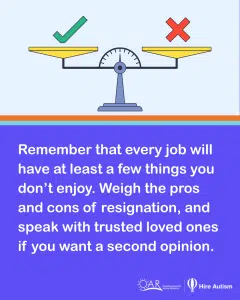
Remember that every job will have at least a few things you don’t enjoy. Weigh the pros and cons of resigning and speak with trusted loved ones if you want a second opinion. Below, we’ve broken down some of those decision-making pathways.
If you enjoy your current employer but find your day-to-day work tasks challenging, consider exploring ways to improve your current situation. The employee handbook, company procedures, or your direct supervisor can be helpful resources for learning about the support options offered by your employer.
If you’re newly onboarded, keep track of what is working and what is not, and bring those reflections to early check-ins and performance reviews. Understanding what you do best can help improve your experience in a current job and is useful to keep in mind if you ever decide to pursue a new role. Additionally, documenting the highlights of your performance can help you advocate for a future promotion, raise, or move within the company to a role that is better suited to you.
If you’ve been in your current role for at least a few months or even a few years, assess which of your required tasks align best with your strengths and see if your employer is open to allocating more of those tasks to you. If you aren’t sure what your strengths are, one way you can learn is to ask your employer about tasks where they thought you exceeded expectations and which skills you have developed the best.
Having an open conversation with leadership about your needs and how they can support your success on the job could transform areas of struggle into opportunities to thrive. Consider discussing simple or creative ways to adapt your daily work experience to create a win-win situation for everyone: you perform better because you receive the tools and support you need to succeed, and your employer is happier because your quality of work improves.
Your needs may fluctuate, and various adaptations may require trial and error, but expressing your needs helps your employer identify ways in which your strengths can shine. For tips on approaching this conversation, review our resource Disclosure and Accommodations with Sample Language.
It can be beneficial to your mental and physical well-being to use sick leave and vacation time. Even in a job you enjoy, rarely taking time off can lead to burnout and an imbalance between your personal life and your professional demands. Review your employer’s policies to see if any perks are going unused, such as access to wellness treatments, fitness facilities, free tickets to entertainment events, and more. These can generate more positive feelings about the rewards you receive in return for the efforts you put in.
If you wish to resign from your current role but need to maintain your employment, set aside time outside of work hours each week for job searching, but don’t neglect your current responsibilities.
 It is best practice to search for a job in your own time and keep your job search private until you are certain you are leaving your current position. Avoid using company-provided equipment for your job search and applications. This is not to be deceitful but to protect your privacy. If you change your mind about resigning or if it takes a while to find the next job before you formally resign, you could encounter awkward or pressured situations once others learn of your intention to leave. Your employer may even consider job searching on the company’s time grounds for termination.
Take this time to evaluate what you don’t like about your current role and what you would like to find next. List your skills and use this information to guide your job search. Without taking the time to assess what you are looking for, you could find yourself in a similar or worse situation.
Also consider which skills you don’t have that might make you more marketable in the industry you seek to pursue. Perhaps there are certifications or courses you can take to upskill and give yourself a better chance in the job market while you still have income to pay for them.
If you feel stuck about where to look for new work, use your current industry knowledge to your advantage. Reflect on other employers in your network with whom you’ve enjoyed interacting, and examine where former employees have found new employment. You are part of a professional tree that has branches extending to new opportunities–you do not need to search without a starting point.
Finally, remember that job searching can take time. Ensure you schedule time for activities outside of employment and your job search that support your mental well-being. You still need to maintain energy for your current employer until you are ready to resign.
If you decide that resigning is the best option, make sure this choice is something you have thought through several times. Avoid quitting reactively in response to one upsetting situation (unless your safety was threatened), so that you do not appear vengeful or ill-prepared to handle conflict.
 Once you are confident in your decision, refer to your employer’s resignation policy for the next best step. It is typically respectful to give notice before resigning, but you should always verify this with your employer’s policy to determine the best course of action. While every employer has a different approach, be prepared to discuss your resignation and departure timeline.
If your employer asks why you are resigning, focus on sharing constructive feedback rather than accusatory feedback, such as listing grievances with certain individuals. Keep it simple—you don’t have to go into detail. For example, you could share something like, “I’ve appreciated the opportunity to work here and the experience I’ve gained. It was time for me to move on to a new opportunity.”
If you continue working for a few weeks after giving notice, a good practice is to close out your short-term tasks and leave notes for those who will assume your ongoing responsibilities. Another good practice is to send thank-you notes to key colleagues, especially those with whom you want to stay in touch after leaving. Keeping your messaging and interactions professional and respectful as you exit increases your odds of maintaining positive relationships with colleagues.
If you’re unsure how to phrase a resignation letter, feel free to borrow wording from the example below:
Dear [Employer Name],
I am writing to give notice of my resignation from my role as [job title] for [company name] effective [date of last day of work]. I am grateful for the growth and opportunities that this role has provided me as I move into this next chapter of my professional journey. Please let me know how I can aid in the smoothest transition out of my duties and if anything else is needed from me at this time. Thank you.
Sincerely,
[Your Name]
People around you may have opinions about the choice you make, and if you value those opinions, a productive conversation can support your decision-making process and help you plan next steps. In the end, though, you know yourself best and which decision is best for you.
Whether you choose to stay in a current role for the long term, temporarily, or to resign, the primary goal is to take care of yourself, both professionally and personally.
Making the Most of Open-ended Interview Questions
The interview process is a critical component of a job application. It is an opportunity for you to connect one-on-one...
Your Support Made the Difference!
Each year, OAR lays out ambitious goals for engaging community members in celebration of Autism Acceptance Month. Throughout the beginning...
How to Write a Resume Without Work Experience
I’ve been supporting autistic adults seeking employment for several years now. One of the questions I get asked the most is: Do...