
In 2020, Sreenidi Bala, a teenager from Farmington, Connecticut, started a passion project that would change the lives of hundreds of autistic students.
Four years later, Bala was named the Prudential Emerging Visionaries Employees’ Choice Award winner for her Code for All Minds initiative. The award came with $10,000 she can use to expand her efforts across Connecticut and throughout the country, and possibly provide technology supplies for students that need it.
Bala saw the potential and talent of neurodivergent students and, as reported by Disability Scoop, created a computer science program called Code for All Minds. The program for neurodivergent students provides educators and families with a curriculum to make STEM career paths possible for young people with learning disabilities, as the press release put out by Prudential described.
The program contains aspects of typical coding software lesson plans, like algorithms, functions, and conditionals. But what makes her project different is the approach Bala took to make the content easily understandable for neurodivergent teens, such as extra video animations specifically suited for autistic learners and a comprehensive guidance page. The special needs students at her Farmington, Conn., high school gave her feedback that helped her create the program, as did input from paraeducators and parents, noted a Connecticut Insider article.
Bala’s passion and inspiration came from her best friend, who is autistic, as well as the inequities she saw in classrooms for children with special needs, the press release reported. She said, “They don’t have the same level of opportunities, and there’s only certain places in society that accommodate them and give them a seat at the table.” The realization that “despite students’ talents and verbal abilities, all of them were being prepared for careers in labor-intensive industries” started her on her journey to create STEM resources for autistic students, she said in the press release. Since Code For All Minds launched, many students with special needs in Bala’s school district have been inspired to pursue technical post-graduate programs.
Not only has Code for All Minds had a tremendous positive impact on the neurodivergent community, but it has also helped Bala herself grow as an ally. “I think that sense of gratefulness and empathy for the student who’s sitting next to you, who may not look just like you, who may not think the same way as you is the most important thing because at the end of the day, we’re all human, and we all deserve the same kindness, respect, belief, and unwavering support,” Bala told Disability Scoop.
 Ben VanHook is an AuDHD (autistic and ADHD) master’s student at George Mason University studying public policy and is currently employed at OAR as the community support coordinator.
With summer heat waves upon us and fall marathons on the horizon, RUN FOR AUTISM’s Bank of America Chicago Marathon and TCS New York City Marathon team members have some tips for beating the heat while logging miles.
Runners agree on two main pieces of advice: start early and hydrate. Aaron Siegel, NYC Marathon runner, recommended starting “the long run before sunrise. You can catch a nap after you get back.” J.P. Destreza, NYC and Chicago runner, agreed, mentioning a 5:18 a.m. start time for a 21-mile run.
Even if you start early, don’t forget sunscreen. “Just because you start a long run at 0:00 dark hundred doesn’t mean you’ll finish in the dark,” said Diane Kellenburger, longtime OAR runner. 
Hydration is also important; with warmer temperatures, you’ll lose more fluids and electrolytes to sweat. For a long run, he recommended planning a route “where there’s water available, like drinking fountains, where you can refill your bottle or stash water at various spots along your route.” If you’re prone to cramping, taking salt tablets can also help.
Running becomes harder when it’s hot out. “Adjust paces using dew points and heat [temperature],” recommended Jamie Rivenburg, Chicago runner. There are many online calculators that calculate how much you should slow down to maintain a similar level of exertion as you would in more favorable conditions. And remember to listen to your body—it’s okay to walk.
No matter the temperature, remember your end goal. Most likely “it won’t be this hot on marathon day,” noted Jillian Howder, Chicago runner.
Hire Autism recently published two new employment-related articles on its website. These articles aim to provide much-needed answers to job seekers’ frequently asked questions. Additionally, each article features input from community members who have experience with the topic.

“Making the Most of Career Fairs” discusses what career fairs are and how they are helpful in the job search process. Career fairs offer many potential benefits to job seekers, including:
- Networking with employers
- Learning more about the industry/field of interest
- Resume review, interview prep, and self-advocacy opportunities
“Processing, Understanding, and Moving Through Job Rejections” explains how rejection is a normal part of the job search process and outlines steps job seekers can take to manage rejection, stay motivated, and strengthen their search after a rejection.
Do you have a topic or FAQ you would like to see discussed in a future article? Email us at mail@hireautism.org.
Siblings of autistic individuals often face similar challenges and stressors, from childhood to adult roles as advocate and potentially caretaker. OAR’s autism sibling support resources provide information that can help. These resources are available online for free and two copies of each can be mailed free as well.
 Autism, My Sibling, and Me
Tailored towards younger children with autistic siblings, this fun and engaging workbook is perfect for children between the ages of 5 and 10. A host of colorful cartoon characters accompany readers and listeners as they learn about what autism means for their brother or sister and how to handle potentially stressful issues. Through activities and supportive content, this resource also helps children work through many of the autism-related questions they may have.
Life as an Autism Sibling: A Guide for Teens
This handbook for teenage (and even pre-teen) siblings offers guidance on how to productively address feelings and challenges that may arise. The resource covers a variety of topics, from explaining autism to friends and peers to coping with a family dynamic that’s different from what friends may experience. It also features testimonials from other teenage and young adult siblings who have “been there, done that.”
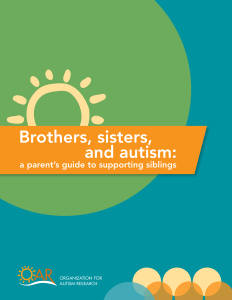
Brothers, Sisters, and Autism: A Parent’s Guide to Supporting Siblings
This guide focuses on what parents can do to support children who do not have an autism diagnosis. Topics range from dealing with perceived discrepancies fairly to facilitating a positive relationship between siblings. The guide also includes testimonials from families who have an autistic family member and deal with similar issues. It can be read from start to finish or used as a reference tool to troubleshoot problems as they arise.
If you have any questions, want to learn more about OAR’s autism sibling support resources, or have ideas about how to expand program offerings in this important area, please e-mail programs @researchautism.org.
Being an older brother to someone with autism spectrum disorder (ASD) is a journey filled with unique challenges and profound rewards. To provide insight into our family and the perspective from which I write, I am the older brother of James, the younger brother of Jacob, and the son of Sherly and Tom. The middle child, to be exact. James was diagnosed with autism at a very young age. As one can imagine, the diagnosis brought a mix of confusion, fear, and ultimately, a deep sense of purpose and understanding into our family dynamics. Jacob and I realized when we were young that a day will come when it is up to us to ensure James is safe, happy, and fully taken care of at all times.
ASD is a wide spectrum, meaning that no two experiences are the same, and we had to learn what worked best for James through trial and error. At one point, we even moved to India for one year for a specialized program. Throughout our lives, my family and I have been leveraging resources, programs, and initiatives to provide James with a sound quality of life.
Things were not always easy early in my life. I often found myself caught between wanting to be a typical teenager and needing to be more mature and understanding than my peers. Social interactions were particularly challenging. Taking James to public places could be unpredictable, and I became acutely aware of the stares and judgments from others when he would have a meltdown in public. It was difficult to explain to friends why I couldn’t always hang out after school or why my house seemed different from theirs.
One of the most difficult aspects of having a sibling with ASD is the unpredictability. Routine changes or unexpected events could trigger anxiety and meltdowns for James. Family vacations, holidays, and even simple trips to the grocery store required meticulous planning and often ended in stress and exhaustion. It was challenging to balance my own needs and desires with my brother’s needs, and there were times when resentment and frustration bubbled to the surface.
Despite these challenges, growing up with James taught me patience and empathy I might not have learned otherwise. I had to learn to communicate with him in ways that made sense to him, often using visual aids or finding creative methods to explain things. This taught me the importance of seeing the world from someone else’s perspective and adapting to meet their needs.
James has a unique way of seeing the world that is both refreshing and inspiring. His ability to focus intensely on his passions is nothing short of amazing. Watching him achieve milestones, no matter how small, filled me with a sense of accomplishment and pride that I couldn’t find anywhere else.
One of the best parts of being James’s sibling is the deep bond we share. Our relationship has taught me the meaning of unconditional love and acceptance. James has an incredible memory and often surprises us with his recall of events and details that we have long forgotten. His honesty and straightforwardness are refreshing, and he makes me see the world differently.
As James grew older, we found a rhythm that worked for our family. We learned to anticipate his needs better and found support through various autism organizations and support groups. These resources provided not only practical advice but also a sense of community and understanding that we desperately needed.
Today, James and I share a relationship built on mutual respect, understanding, and love. He continues to amaze me with his growth and resilience. We have learned to celebrate his unique strengths and support him in areas where he faces challenges. Our bond is stronger than ever, and I am grateful for the perspective and depth he has brought into my life.
James has shown me the beauty of seeing the world through a different lens and has inspired me to pursue a path of advocacy and support for others facing similar challenges. Our relationship is a testament to the power of love, resilience, and the unbreakable bonds of family. Despite the difficulties, I would not change our journey for anything. He is my motivator to always strive for success and be the best person I can be. He has shaped me into the person I am today and given me a sense of purpose and understanding that I will carry with me for the rest of my life.
 Joseph Mangalasseril Thomas serves on OAR’s Board of Directors. He has also been a peer coach for Special Olympics, and has taken other roles in related opportunities in the Chicago area. His leadership positions stretch across several organizations that include titles such as co-founder, chairman of the board, two presidencies, and four director positions. He is currently the manager of global sourcing at Medline Industries and the president of JT Mang. He is a graduate of Miami University, Oxford, Ohio.
In November, OAR’s Board of Directors authorized funding for eight applied autism research studies in 2024. These new grants, totaling $297,569, bring OAR’s total research funding to more than $5 million since 2002. This article is sixth of eight previews to be featured in The OARacle this year.
Autistic children are reported to be five times more likely to experience feeding difficulties than neurotypical children. A 2023 study confirmed that autistic symptoms and feeding difficulties are strongly correlated. Specifically, autistic children are significantly more likely to be underweight or obese, show a greater degree of inadequate intake, and show elevated levels of food selectivity and rigidity.
While practices used in treating feeding difficulties vary, the American Academy of Pediatrics and the World Health Organization recommend responsive feeding. In responsive feeding, the parent acknowledges the child’s acceptance or rejection of food without the use of enticement or rewards, such as supplying access to toys or praise following consumption. If the child refuses to eat or drink, the parent removes the food or drink. For typically developing children, the responsive feeding approach has been associated with decreased fussiness and increased enjoyment during mealtimes per parent reports.
While there is no published research on whether responsive feeding is appropriate for autistic children, some feeding specialists use it. To date, the only evidence-based approach is behavioral intervention. Behavioral feeding focuses on increasing desired feeding behavior with reinforcement—providing rewards—and restricting reinforcement when the behavior is not performed.
In her one-year OAR-funded study, researcher Laura Phipps, Ph.D., will examine both approaches to see which is more effective. The goals of the study, “Feasibility and Efficacy of Assessing Child Preference for Feeding Treatment Using Choice Assessment,” are to:
- Compare the efficacy of responsive and behavioral treatment for autistic children with feeding difficulties
- Conduct an assessment to determine which approach autistic children prefer
- Compare child and parent preferences for treatment approaches
The study results will provide knowledge for clinicians about which approach may be more effective and to incorporate patient autonomy into treatment without sacrificing effectiveness.
Dr. Phipps is an assistant professor of psychology at the University of Nebraska Medical Center’s Munroe-Meyer Institute. Her research focuses on improving treatment for pediatric feeding disorders. She is the clinical director of a program that provides early intervention therapy for children with autism and feeding difficulties. She also has training and expertise in applied behavior analysis and neurodiversity.
Methodology
The research team will recruit 10 autistic children and parents from the pediatric feeding and autism center waitlists at the Munroe-Meyer Institute, which serves a diverse group of patients. The children will be between 4 and 12 years old and must engage in disruptive behavior during meals.
Children and parents will attend a one-hour session weekly for three weeks. The child will be taught to touch cards, each with a distinct black-and-white pattern that matches a pattern taped to each of the room’s three doors. The patterns are assigned to study conditions: responsive feeding, behavioral feeding, and no-treatment.
When the child touches a card, they will enter the room for that treatment. After treatment, the researcher will prompt the child to select a new card. In each session, the child will complete at least 10 exposures to each treatment. Parents will implement the procedures and the instructors will communicate via an earbud to guide them as needed.
In responsive feeding treatment, the child’s parent will present the target food and tell the child to take a bite if they want to. If the child indicates that they do not want to, the parent will remove the food and wait for up to two minutes for the child to indicate interest. If the child indicates interest, then the parent will present the same bite and continue until all three bites are presented or until two minutes elapses. If the child consumes a bite, the parent will not provide praise but will provide descriptive statements about the food, such as “the bite made a crunch!” If the child does not participate within two minutes, the session ends.
For behavioral feeding, the parent will present the target food and tell the child that if they take a bite, then they can play. If the child indicates they do not want to complete the task, the parent will keep the food within arm’s reach of the child for up to two minutes and then remind the child that if they take a bite, they can have their toy and tell them that they will wait until the child is ready. While the parent waits, they will engage in a diverted-attention activity, like reading a book, for example. If the child does not participate before time is up, they will not receive the toy. If the child does eat the bite, the parent will provide a reward and praise.
In the no-treatment control condition, the parent will present the target food with no instruction and without giving the child the opportunity to earn a reward. Parents will be asked to remain neutral and not make any statements about the food. There will be no consequences for either appropriate or inappropriate mealtime behavior.
After the child has experienced each of the three conditions, the instructor will begin the preference assessment. The instructor will present all the cards and tell the child to pick the card for the room they want to go to. Once the child selects a card, the parent and child will enter the selected room and complete the corresponding treatment. The child can choose to leave the room after the first bite is presented and make a new choice if they wish.
How long the child spends in each room will serve as a corresponding check of preference in addition to the number of times a child chooses each card. The process will be repeated until the child shows a clear preference or 20 sessions are conducted and preference is not demonstrated, indicated by the child selecting treatments in similar proportions.
Evaluation
Dr. Phipps will compare the effects of the two approaches, using rates of appropriate and inappropriate mealtime behavior. If, for example, negative vocalizations and inappropriate behavior decrease while appropriate behavior, happiness, and approval increase, then the research team can conclude that there is a chance the treatment led to improved behavior.
The preference assessment will be evaluated based on the number of times each child selects a treatment. If a child selects one treatment more than others for three consecutive sessions, then the selected treatment will be considered preferred. If the child does not select one treatment more than others for three consecutive sessions, then no treatments will be considered preferred.
Parents will be asked to indicate their preference for either responsive feeding, behavioral feeding, or neither after the study. They will also be able to provide comments about which components of each approach they liked or disliked and why, as well as how they felt each approach matched with their cultural norms for mealtimes.
Practical Relevance
This study aims to ameliorate the challenges of pediatric feeding difficulties by examining which treatment techniques are effective as well as evaluating child preference. Having that information could change the standard course of treatment for a child and positively impact their experience with feeding treatment. A range of potential outcomes for this study could have implications for children’s individual treatment experiences as well as future research.
The preference assessment protocol and responsive and behavioral treatment protocols will be available for practitioners and researchers to modify and replicate. This knowledge will serve as a tool for prioritizing patient autonomy and incorporating choice into a child’s daily life.
Strengthening the existing treatment for pediatric feeding difficulties and examining how it can be tailored toward the autistic population is critical because pediatric feeding difficulties are strongly associated with a less healthy quality of life and with exacerbating the social difficulties associated with autism. Mitigating the effects of pediatric feeding difficulties can reduce those challenges.
Sherri Alms is the freelance editor of The OARacle, a role she took on in 2007. She has been a freelance writer and editor for more than 20 years.
Siblings of autistic individuals experience both benefits and challenges related to their sibling relationships. Benefits often include greater empathy, compassion, and resilience. Challenges can include parentification (i.e., acting in a parental role in childhood), struggling to plan for future caregiving, and responding to challenging behaviors.
Parents often report worrying about the experiences and well-being of their neurotypical children. It is important for parents to remember that there are many benefits to having autistic siblings. These suggestions may help alleviate those worries.
Educate About Autism
If you have recently received an autism diagnosis for one of your children, it is important to educate your entire family, including your neurotypical children, about autism. You can share books, articles, social media posts, and/or videos from autistic individuals, depending on the needs and preferences of your family member. This may help educate your children about autism as well as provide a firsthand narrative from an autistic person.
Address Concerns About the Future Directly
Siblings often report wanting to talk to their parents about the future. Even young siblings are often thinking about the future. They may be planning to live with their autistic brother or sister. They may be contemplating serving in a caregiving or supportive role. Research shows that future planning benefits parents, neurotypical siblings, and autistic individuals. Yet, siblings report that their parents are often reluctant or even refuse to talk about the future.
Planning should include the sibling and the autistic individual, as both should have input in their future. Future planning needs to be flexible. However, having a plan can help assuage any anxiety that may exist among siblings. As a resource, consider The Arc’s Center for Future Planning.
Provide Individual Time with the Neurotypical Child
Parenting is hard under any circumstance. Parenting an autistic child can pose its own obstacles, given the many systemic barriers to accessing needed supports. With competing demands on your time as a parent, it can be hard to carve out time with each child. Respite care can provide you with time to spend individually with each of your children without autism. You may be eligible for waivers that will pay for the care.
Address Challenging Behaviors
If your autistic child exhibits challenging behaviors, it is important to address the behaviors with your neurotypical children. You may consider teaching your neurotypical children how to respond to challenging behaviors and ways to prevent those behaviors from occurring. These suggestions can help:
- Include your neurotypical children in a functional behavior assessment, which identifies the cause of the behavior and addresses their safety and well-being.
- Identify a code word indicating a crisis to signal to the neurotypical sibling/s to go to a specific place for safety. You may also practice responding to the code word especially when you anticipate potential challenging behavior.
You may also consider the unintended impact of challenging behaviors on siblings. Even when behaviors are not occurring, siblings may be nervous or anxious at the prospect of those challenging behaviors. Talk to your children about their concerns. Discuss ways to cope with uncertainty. These strategies may also help.
Consider Enrolling Your Child in Sibshops
Siblings of autistic individuals often report that they would like to meet and befriend other siblings of autistic individuals. Autism is a unique experience. It can be helpful to meet others with similar lived experiences. Yet, siblings often report that they do not meet another sibling of an autistic individual until they reach adulthood.
To help create a support network for your neurotypical child, look into whether there is a Sibshop in your community. Sibshops were created for young children, ages 8 to 13, to provide siblings an opportunity to meet one another, discuss shared experiences, and benefit from peer support. There are Sibshops for children as young as six and for teens as well. Find a Sibshop in your community.
As with all sibling relationships, having an autistic brother or sister often yields both positive and negative experiences. These sibling relationships ebb and flow over time, just like all relationships do. I hope that the abovementioned strategies are useful to you; if not useful now, they may be useful in the future.
 Meghan Burke, Ph.D., is a professor of special education at Vanderbilt University. Her research interests include advocacy, families of individuals with disabilities, and disability policy. Her research examines how families advocate for services for their family members with disabilities and how siblings of individuals with disabilities transition to caregiving roles. She has lectured widely and published articles in scholarly journals such as Autism, American Journal of Intellectual and Developmental Disabilities, and Journal of Special Education. She is co-author of Families and Professionals: Trusting Partnerships in General and Special Education, 8th Edition, and Exceptional Lives: Practice, Progress, and Dignity in Today’s Schools.
I love to travel! It’s fun getting out of the house and exploring a new environment. But for us autistic people, traveling can bring some unique challenges. That is why I’m here to help you plan and execute a successful vacation as an individual on the autism spectrum.
Plan for Accommodations
Traveling as an autistic person can be challenging, so it’s essential to plan for accommodations. For example, you can request a guided assistant at the airport if you’re traveling by plane. Or if you’re noise-sensitive and staying at a hotel, you can request a room away from the elevator so that it’s quieter. It’s ok to ask for accommodations because they’re here to make our life experiences better.
Pack Comfort Items
When I travel, I make sure to pack my fidget toys so that I have something to keep my hands busy. Other comfort items you might pack to have a comfortable vacation might be noise-canceling headphones, a stuffed animal, an MP3 player, or snacks. This is your vacation, so make sure you have the items that comfort you.
Have a Game Plan and Go Over It
Uncertainty can be scary for a traveler on the spectrum. It can make us feel anxious and stressed. That’s why knowing what you will do each day on a vacation and reviewing the plans is helpful. It minimizes the uncertainty of new experiences and lets you know what to prepare for. When I traveled to Washington, DC in 2022, I made sure to plan what I would do each day. For example, the first few days would be for sightseeing and then the rest of the trip would be spent at the Association of University Centers on Disabilities (AUCD) Conference.
Be Organized (Or At least Try to Be)
If you’re like me and have ADHD also, being organized is tricky. Organization feels like a foreign concept, but it’s crucial for traveling so that you know what to bring and where it is. I try to start packing for a vacation at least one week before it begins so that I can start getting my stuff together, and whatever I’m missing or need to clean, at least I have time to take care of it. I’m leaving for a vacation with friends in a couple of weeks. This is going to be a week-long vacation, so I need to make sure I make a list of everything I need so that I do not miss anything.
Going on a vacation is fun, and with some help, autistic people can travel too. The way we travel might look different, but we have equally as much fun getting out of the house and doing it. I hope these tips help you have a fun vacation. Happy traveling!
 Tiffany Richard is a self-advocate for disability rights. She is autistic and passionate about changing the narrative of autism. She resides in Louisiana with her three cats. In her free time, she enjoys coloring pictures, playing with her cats, and reading.
I had never considered raising money through my running. After all, I love to run. Why should anyone pay me to do it? I (mostly) don’t think of running as suffering, but as an activity that brings me joy, connection and satisfaction. The only reason I decided to fundraise is that I wanted to run the London Marathon and it’s almost impossible to get into London through the lottery. When I filled out the application for London last year, I checked the box that I would be interested in a charity bib.
Of course, I didn’t get into to London through the lottery. But Organization for Autism Research (OAR) was one of the charities you could apply to run for. Our daughter had been recently diagnosed as autistic, just a few months shy of her sixteenth birthday. I had two friends who had run for OAR and they raved about the experience. It seemed like a perfect fit. I submitted my application and was accepted. I was so excited! And a little nervous. I had never raised more than a couple hundred dollars for anything and now I had six months to raise $5500. Yikes.
A friend who is a professional fundraiser gave me the best advice. She said, when we ask people for money, we are doing them a favor. Most people want to do something good in the world, but they don’t know what to do. When we offer friends and family the opportunity to donate to an organization we care about, we are giving them a clear path about how they can help. The first few times I asked for money, it was challenging, but I kept her advice in mind and it got easier. Asking for money became a chance for conversation and connection. A friend donated and then two more donations came in – from her mother and her aunt. It turns out my friend’s cousin is autistic. That’s just one story, but variations on this theme happened often. I got to know people better by asking for donations. I had not expected that.
I was also determined to make fundraising FUN. My husband and I have given a lot of money (for us) to a local mental health foundation because their main fundraiser is a dinner with fancy desserts, a live auction, and a hilarious trivia contest. At the end of the night, we’ve had a great evening out with friends and supported a cause we care about.
I knew I couldn’t do an upscale gala, so instead I organized an “All Ages Happy Hour” at a local café that serves beer and wine along with coffee and pastry. I asked local businesses to donate prizes for a raffle. I ordered infinity rainbow pins to give away and we put up rainbow balloons. We turned it into a party! We gave away the infinity rainbow pins to everyone who came into the café. I had planned some games but everyone was so busy talking that we didn’t end up playing them. The owner of the barbershop next door came in. It turns out he is autistic and he was excited to learn about OAR. The café is considering scheduling an event for families with sensory sensitivities. It wasn’t a huge gala, but it was genuinely fun and the “All Ages Happy Hour” raised a lot of money.
By the end of the campaign, I had raised over $7000 dollars. It turns out that the things I love about running – joy, connection, and satisfaction – were also possible through fundraising. I plan to learn what I used raising money for OAR to help other organizations in my local community and I look forward to running for OAR again in the future. I am so grateful for opportunity OAR offered me. Thank you!
 Sarah Elise Wiliarty is an Associate Professor of Government at Wesleyan University specializing in European politics. Her daughter Geneva was diagnosed with autism and ADHD at the age of 15. Sarah is a passionate runner and coach. She has run sixteen marathons and countless other races. She and Geneva enjoy baking and traveling together.
ARLINGTON, VA, June 7, 2024 – The Organization for Autism Research (OAR) is delighted to announce the recipients of its 2024 Graduate Research Competition. The program offers up to $1,000 to master’s students and $2,000 to doctoral candidates or post-doctoral students to conduct autism-focused research. This year, OAR is awarding five grants totaling $7,199. These newly funded grants are a part of the more than $329,266 awarded to fund 193 graduate research studies since 2004.
OAR received 27 study proposals this year from graduate students across the world. Members of the OAR Scientific Council, a group of 18 autism professionals from a variety of fields and backgrounds, reviewed and scored each proposal. Their evaluation was based on three key criteria:
- Alignment with OAR’s research priorities
- Methodological soundness
- Relevance of potential findings for those affected by autism
In keeping with OAR’s dedication to high-quality research, only the best of the best proposals were selected for funding.
Congratulations to the 2024 grant recipients:
Tianna Etes, Oklahoma State University
Trust Me, I’m a Therapist: Investigating the Role of Mistrust in Mental Health Service Utilization and Well-Being among Black Mothers of Autistic Children
Christina Layton, University of Rochester
An Investigation of the Complex Relationships between Sensory Reactivity, Coping Strategies, and Mental Health in Autistic Adults
Renming Liu, Baylor University
Caregiver Assisting in Developing Independent Daily Living Skills (AID)
Viviana Morales, Felician University
Challenges Faced by Latino Families in New Jersey to Access and Maintain Evidence-Based Interventions for Children with Autism Spectrum Disorder
Luciana White, York St. John University
Autistic and Not Lonely: A Creative and Participatory Exploration of How Autistic Adolescents Experience Loneliness
For inquiries regarding the Graduate Research Grant Program or for more information on the 2025 funding cycle, please contact OAR at 571-977-5391 or e-mail at research@researchautism.org
About OAR: The Organization for Autism Research (OAR) is a national non-profit organization formed and led by relatives of children and adults with autism. OAR is dedicated to promoting research that can be applied to help families, educators, caregivers, and individuals with autism find much-needed answers to their immediate and urgent questions. Learn more at www.researchautism.org.
